





If you have been looking at new single-board computers, mini PCs, or AI devices, you have probably noticed the Rockchip RK3588 popping up again and again. It is one of those chips that suddenly became very common, and people keep choosing it for new products. At first, it may look like just another processor name, but once you understand what it offers, it becomes clear why it gets so much attention.
What the Rockchip RK3588 actually is
The Rockchip RK3588 is a system on a chip, which means it combines many parts of a computer into one piece. Instead of having separate components for processing, graphics, and AI, everything is built into a single chip. This makes devices smaller, more efficient, and easier to design. In simple terms, the RK3588 is like a compact brain that can power a full device, whether it is a small computer, a smart display, or an AI box.
What makes the RK3588 interesting is that it is not focused on just one thing. Some chips are strong in graphics but weak in AI, while others are good for simple tasks but cannot handle heavy workloads. The Rockchip RK3588 tries to balance everything. It gives you solid CPU performance, modern graphics, built-in AI processing, and strong video support all in one place. This is why it is often used in devices that need to do more than just basic tasks.
Performance and everyday experience
When people talk about performance, they usually start with the CPU performance: It uses a mix of fast and efficient cores. When you open apps or something, the system feels smooth, and performance is good. It is not meant to replace a high-end desktop computer, but it will be a good choice to have this option. You can browse the web, run development tools, or even use it as a small server without much trouble.
Graphics are another area where the Rockchip RK3588 shows clear improvement compared to older chips. The built-in GPU supports modern graphics technologies, so interfaces feel fluid and animations do not stutter. This matters more than people think, because even simple things like scrolling or opening windows depend on good graphics performance. It is also capable of handling light 3D workloads, which makes it useful for visual applications and some creative tools.
AI and video – the biggest advantages
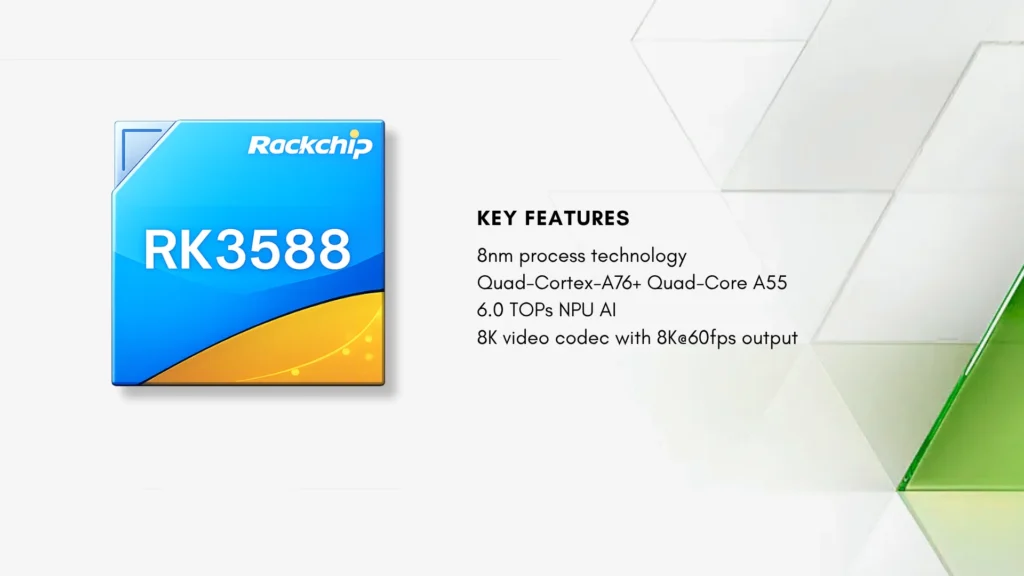
One of the biggest reasons why the RK3588 stands out today is its AI capability. It includes a neural processing unit that can handle machine learning tasks directly on the device. This means you can run things like image recognition or object detection without sending data to the cloud. In real life, this is important for privacy, speed, and reliability. Devices can react instantly because they do not need to wait for a server response. This is why the RK3588 is often used in edge computing systems etc.
Another strong point is video support. The Rockchip RK3588 can handle very high-resolution video, including 8K decoding. Even if most people do not use 8K content every day, this shows how much processing power is available. For media devices, digital signage, or streaming systems, this is a big advantage. It also means the chip is more future-proof, since video quality keeps improving over time.
Connectivity and flexibility
Connectivity is also important, and the Rockchip RK3588 offers many options. It supports fast storage, external devices, and high-speed networking. This makes it flexible and suitable for more serious projects, not just simple hobby use. You can build a device that connects to cameras, sensors, displays, and storage at the same time, and the chip can handle it.
Comparison with other Rockchip chips
To better understand where the RK3588 stands, it helps to compare it with other chips from the same family.
| Feature | Rockchip RK3588 | Rockchip RK3566 | Rockchip RK3399 |
| CPU | 8 cores (A76 + A55) | 4 cores (A55) | 6 cores (A72 + A53) |
| Frequency | up to ~2.4 GHz | up to ~1.8 GHz | up to ~2.0 GHz |
| GPU | Mali-G610 | Mali-G52 | Mali-T860 |
| AI support | Yes, up to 6 TOPS | No | No |
| Video | up to 8K | up to 4K | up to 4K |
| Process | 8nm | 22nm | 28nm |
Looking at this, it becomes clear that the RK3588 is built for more demanding use. It offers more performance, better video support, and built-in AI, which older chips simply do not have. Compared to RK3566, the difference is very noticeable, and compared to RK3399, it feels like a completely new generation.
Also, the Cortex-A76 cores are the big or performance part of the RK3588’s processor. Think of them as the strong, fast workers on the team.
Real devices based on RK3588
In real-world use, the RK3588 can be found in many types of products. One common example is single-board computers. These are small boards that work like a full computer, and they are used by developers. Devices like KiwiPi 5B and KiwiPi 5 Pro are built around the Rockchip RK3588 and show what this chip can do in practice. They can run Linux or Android, handle multiple tasks, and support various peripherals. We also develop products based on the RK3588, especially in the area of single-board computers and AI devices, where this chip offers a strong balance between power and flexibility.
And yes, we have written some articles about KiwiPi 5 CPU/RAM benchmarks, as well as material about top AI boxes in 2026, including a product based on Rockchip RK3588.
Another common use case is AI systems. Because the RK3588 can process AI workloads locally, it is used in smart devices that need quick responses. This includes things like security cameras, recognition systems, and automation tools. Instead of relying on cloud servers, these devices can work on their own, which improves speed and reduces dependency on internet connections.
Media devices are also a natural fit for the RK3588. With its strong video support, it can handle streaming, playback, and display tasks easily. This makes it useful for home entertainment systems, digital signage, and interactive displays. The ability to handle high-resolution video smoothly is a key advantage here.
Things to keep in mind
Of course, there are also some downsides to consider. The software ecosystem is still growing, it is not always as polished as more mature platforms. Some users may need to spend time setting things up or optimizing performance. Power consumption can also be higher compared to simpler chips. Still, for most use cases, these are manageable trade-offs.
Conclusion
Overall, the Rockchip RK3588 is popular because it offers a strong mix of performance, features, and flexibility. It is powerful enough for demanding tasks, but still compact and efficient enough for embedded systems. It bridges the gap between simple chips and full desktop processors, which is why it is used in so many modern devices. If you need a solution that can handle AI, video, and general computing at the same time, the RK3588 is one of the best options available today.
Sources
Rockchip Resources – https://rockchips.net/datasheets/
Rockchip Wikipedia Page – https://en.wikipedia.org/wiki/Rockchip
FAQ
Is the Rockchip RK3588 good for everyday use? Yes, it is strong enough for daily tasks like browsing, development work, and running applications on Linux or Android, and it feels smooth in most situations.
Can RK3588 be used for AI projects?
Yes, this is one of its main strengths, since it has a built-in NPU that allows it to run AI models directly on the device.
How does RK3588 compare to older Rockchip chips?
It is much more powerful and modern, especially because of its AI support, better CPU cores, and improved video capabilities.
What devices use RK3588?
It is used in single-board computers, AI boxes, media players, and industrial systems, including boards like KiwiPi 5B and KiwiPi 5 Pro.
Can RK3588 replace a desktop computer?
It can handle many basic tasks like browsing and light work, but it is still not a full replacement for a high-end desktop in heavy workloads.